ePRO Software for Clinical Trials & Real-Time Patient Reporting
ePRO software for clinical trials
oomnia ePRO software is a real‑time electronic patient‑reported outcomes solution designed for patient data entry within a fully unified clinical research information system (CRIS).
Unified data capture
What is oomnia ePRO data capture?
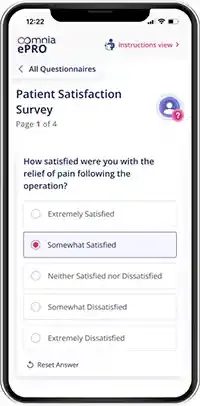
oomnia ePRO software is an electronic patient‑reported outcomes solution designed to capture patient data directly within a unified clinical research information system (CRIS). It enables participants to submit symptom reports, quality-of-life measures, event-driven entries, and scheduled assessments in real time, using either site-provided hardware or their own personal devices.
oomnia ePRO eliminates the need for separate apps by providing a seamless, integrated patient reporting environment. This eliminates paper‑based steps and manual oversight, reducing site workload while giving teams immediate visibility into patient‑submitted data.
CLINICAL DATA
What is oomnia used for in electronic patient reported outcomes (ePRO) and data capture?
oomnia ePRO captures patient-reported outcomes directly from participants across any device, without separate portals or manual data re-entry. It is built for sponsors, CROs, and sites that need real-time PRO data integrated with their study database from day one.
oomnia ePRO supports:
-
Real-time patient data entry from any device
-
Real-time data availability across EDC and CTMS
-
Automatic integration with study database
-
Automated alerts and reminders
-
All patient‑reported data in one unified system
-
Automated data consistency checks
Key Capabilities
Key capabilities of oomnia ePRO software
| Aspect | Modular eClinical systems | Unified clinical trial software (oomnia) |
|---|---|---|
| System architecture | Separate ePRO application connected to EDC via integration | Native module inside one unified Clinical Research Information System (CRIS) |
| Patient access | Separate patient portal or app | Mobile & web access within one connected study environment |
| Data availability | Data synced to EDC via API or scheduled transfer | Instant real-time availability across modules |
| Data model | Independent database requiring mapping to EDC | Shared structured data model across patient and site data |
| Questionnaire configuration | Vendor-configured or limited customization | Configurable GUI builder with flexible scales, formats, and reusable templates |
| Patient engagement | Manual reminders or basic notifications | Automated reminders, configurable schedules, adherence tracking |
| Integration with study database | Requires synchronization with EDC and operational systems | Automatically integrated with unified study database |
| Device flexibility | Limited or inconsistent support for personal devices; often requires provisioned hardware | Bring‑Your‑Own‑Device support with optimized mobile and web experience across device types, reducing site burden and improving patient convenience |
| Audit & traceability | Separate audit trail per module | Detailed audit trail across all modules and patient interactions |
| Security & compliance | Module-level security controls | Encrypted data, role-based access, and CRIS-wide regulatory compliance framework |
Regulatory Readiness
Compliance and validation
oomnia ePRO software supports common compliance expectations including GxP-aligned practices, 21 CFR Part 11–supporting controls, and ICH-GCP. Key controls and trust signals include role-based access control for patient-reported data, secure authentication and session management, encryption in transit and at rest, and full audit trails that record key actions and changes across the system.
FDA PRO guidance
Aligned with FDA guidance on patient-reported outcomes in clinical trials
21 CFR Part 11
Fully compatible with electronic records and signature requirements
ICH-GCP
Workflows structured in accordance with ICH-GCP standards
Role-based access control
Granular access management per user, site, and study
Complete audit trails
Time-stamped entries and full data traceability
GDPR & HIPAA
Patient data protected in compliance with global data protection regulations
How It Works
How oomnia ePRO works inside a unified clinical trial software?
Unlike traditional ePRO systems that function as isolated tools, oomnia ePRO software is a part of the unified clinical research information system (CRIS). This means:
No separate patient‑facing portals or disconnected reporting apps
No re‑entry of patient data into downstream systems
Shared data structures across patient‑reported and site‑reported information
One consistent audit trail covering all patient interactions and system events
Fewer reconciliation steps between ePRO, EDC, and operational modules
Aligned terminology and forms across study functions
Real‑time visibility into patient submissions, compliance, and trends
Who This Is For
Who oomnia ePRO is for
oomnia ePRO software is designed for:
Sponsors aiming to improve patient‑reported data quality across global studies
CROs managing decentralized or hybrid trials requiring real‑time patient insight
Research organizations replacing manual workflows or fragmented ePRO apps
Teams seeking higher compliance and reduced site workload through automation
The Platform
All clinical trial tools unified in one clinical trial platform
EDC software
Unified Electronic Data Capture system for compliant, real-time clinical data collection
CTMSCTMS software
Automated trial management solution designed to streamline study oversight
ETMFeTMF software
Digital workspace for storing, managing, and accessing trial master file documents
ECONSENTeConsent software
Electronic informed consent solution designed for seamless participant consent capture
ECOAeCOA software
Capture patient-reported outcomes, clinician assessments, and study data in real time without paper workflows
RTSMRTSM software
Randomization and Trial Supply Management system that automates treatment allocation and blinding in real-time
ESOURCEeSource clinical trials
Electronic source system that captures original site data in real time, fully validated and without manual transcription
Get Started
Ready to bring your clinical data together?
Replace fragmented systems with a unified clinical trial software and gain real-time visibility across your trials.
Talk to our teamResources
ePRO resources
ePRO
Wemedoo returns to Xraised episode 2 with unified data in focus
July 9, 2026
Making oncology data work: Wemedoo’s latest scientific contribution!
June 24, 2026
Artificial Intelligence in Clinical Trials: Balancing Innovation and Accuracy
June 24, 2026
A new scientific publication featuring Wemedoo researchers has been published in BMC Medical Research Methodology
June 24, 2026
Interoperability: The Missing Piece in Clinical Trial Efficiency
June 24, 2026
The CRO’s Guide to Winning Sponsor Trust
June 24, 2026
Key Takeaways from EUCROF25: AI, Integration, and CRO Challenges in Clinical Trials
June 24, 2026
Wemedoo Becomes an Associate Member of EUCROF
June 24, 2026
Across Global Alliance Selects oomnia as a Central Trial Infrastructure
June 24, 2026
Revolutionizing Clinical Trials: How Wemedoo is Accelerating Global Research
June 24, 2026
Why does unified data matter? Hear from Wemedoo at Swiss Biotech Day!
June 24, 2026
Wemedoo in The CEO Magazine: Fixing Clinical Trials
June 24, 2026
Wemedoo in Forbes: From Clinical Frustration to Real Innovation
June 24, 2026
New Era of Clinical Trials with oomnia®: Built for Complexity, Designed for Simplicity
June 24, 2026
From consent to compliance in patient-centric clinical trials
June 24, 2026
Reducing costs and standing out as a CRO
June 24, 2026
Dr. Nikola Cihoric elected to EUCROF AI Expert Group
June 24, 2026
Wemedoo announces strategic partnership with mediri to streamline imaging data management in clinical trials
June 24, 2026
Wemedoo’s innovation journey with oomnia on Xraised
June 24, 2026
Accessing better technology for clinical trials
June 24, 2026
The hidden cost of disconnected systems in biotech and the path to streamlined trials
June 24, 2026
Wemedoo receives SCDM innovator start-up of the year 2025 award
June 24, 2026
Wemedoo featured on BioSpace
June 24, 2026
Wemedoo joins Xraised again to share new perspectives
June 24, 2026
Wemedoo featured on AP News
June 24, 2026
Clinical trial trends in 2025
June 24, 2026
Why eClinical architectures have reached their limits, and a new category is emerging
June 24, 2026
Handling complex data in oncology trials
June 24, 2026
Why compliance risk increases in modular eClinical setups
June 24, 2026
The system architecture behind the data reconciliation challenge in clinical trials
June 24, 2026
What makes a clinical trial software truly unified
June 24, 2026
Solving MedTech trial complexity with the right technology partner
June 24, 2026
Frequently asked questions
What is ePRO software in clinical trials?
ePRO (Electronic Patient-Reported Outcomes) software enables clinical trial participants to report their health data, symptoms, and quality-of-life measures directly from their smartphone, tablet, or computer. Wemedoo's oomnia ePRO captures cleaner data, improves patient engagement, and provides real-time insights to clinical teams.
How does oomnia ePRO improve data quality compared to manual workflows?
Patients submit information on their devices, removing the need for sites to re-enter handwritten notes and eliminating transcription-related mistakes. Real-time submission ensures data is captured at the moment experiences occur, which reduces memory-based inaccuracies and improves the overall reliability of patient-reported outcomes.
What types of patient data can oomnia ePRO software capture?
- Direct patient-reported inputs
- Clinician-entered assessments
- Observer-reported information
- Event-driven diaries
- Image uploads
- Dynamic questionnaires
- Device and wearable data
Can oomnia ePRO connect with wearables or digital health devices?
Yes. oomnia ePRO can interface with supported wearables or digital health devices, allowing continuous patient data streams to be combined with ePRO submissions in a single environment.
Does oomnia ePRO work seamlessly with EDC, or does it function separately?
oomnia ePRO is built to operate within the same unified environment as the EDC, allowing patient-reported information to appear in the study database instantly.
Can oomnia ePRO be customized for different protocols?
Yes, oomnia ePRO supports fully customizable surveys and questionnaires that can be tailored to any clinical trial protocol. Validated instruments like PRO-CTCAE, EQ-5D, and SF-36 can be configured, and custom scales can be built using the drag-and-drop form designer.
What devices support oomnia ePRO?
oomnia ePRO works on any device including smartphones (iOS and Android), tablets, laptops, and desktop computers through a responsive web-based interface. Patients can complete their assessments from home or at the clinical site without installing any apps.
How does ePRO integrate with EDC in oomnia?
oomnia ePRO data flows directly into the unified EDC system in real time, with no separate data transfers or reconciliation needed. This means clinical teams can view patient-reported outcomes alongside all other trial data from a single dashboard.